• I’ve added a casual chat room to CookingBites as a place for off-topic banter, light conversation, and short-lived chit-chat that doesn’t belong in forum threads. The chat room is informal and lightly-to-not moderated, with messages being temporary, so it’s ideal for friendly back-and-forth that would otherwise derail discussions. Site rules still apply, but there’s no reporting system or expectation of post-by-post moderation - if something becomes uncomfortable, the right response is to step away. If a topic has substance or lasting value, it still belongs in the forums; everything else can head to chat.

Yogurt Methodologies

And it's good! 👌
Fantastico! 👍

I've now got a quart of whey to use that I got from this batch and the last one. I think I'll take all my bought bread and make pudding and make me a rustic sourdough loaf with the whey. 🤔
That's a thing isn't it. I've never known what to do with whey. I know Morning Glory mentioned whey a while back, too. Must do some research 💡💡
 
karadekoolaid Hey there, so I'm seeing references to Indian, like India, yogurt fermenting crocks that are unglazed crockery. Any input being versed in food things from India?
 
Indian cookery uses loads of yoghurt, but I can't say I've ever made any.
When we did make yoghurt, it was with a little machine.
Let me see if I can dig something up on my Indian websites.
Thank you I just thought you might have it off hand. I've got a machine but am always curious to methods, pros, and cons. 🙏
 
Just had a quick look at 4 of my favourite Indian home cooks. They don't seem to care too much about what you put it in, but two things stand out:
1) Boil the milk (preferably whole milk) and stir a few times to prevent it sticking to the bottom of the pan. Once it's boiled, whisk it a few times and then simmer for about 10-15 minutes.
2) Allow to cool to 110-115F before you add 1-2 tsps of natural yoghurt (the starter). The temperature is very important, apparently. Mix well, then leave for about 6-7 hours.In winter, they recommend 2 tsps.
That's all I've got right now, but I'll take another look tomorrow.

 
Just had a quick look at 4 of my favourite Indian home cooks. They don't seem to care too much about what you put it in, but two things stand out:
1) Boil the milk (preferably whole milk) and stir a few times to prevent it sticking to the bottom of the pan. Once it's boiled, whisk it a few times and then simmer for about 10-15 minutes.
2) Allow to cool to 110-115F before you add 1-2 tsps of natural yoghurt (the starter). The temperature is very important, apparently. Mix well, then leave for about 6-7 hours.In winter, they recommend 2 tsps.
That's all I've got right now, but I'll take another look tomorrow.
Thank you! That's about what I've got. I'm adding around 70ml of yogurt for starter per qt/liter. 110 is my machine temp and I do boil it to 180, breaks down the casein so it gets thicker.

Thank you! 👍
 
I've always made yogurt without a machine, same method and temps as mentioned above, except I don't simmer to reduce the milk. I think that method is quite common in Europe. I know that in India milk is often reduced by simmering for a variety of dishes and foods to slightly thicken and make richer. Similar in some ways to the way clotted cream is made by simmering full cream milk.

I have a couple of lidded glass jars I always use and I usually let them sit in a warm spot overnight sometimes a little longer to set the yogurt. A machine might be really handy.
How are you liking using this one?
 
I don't simmer either.
Just bring up to temps just below boil. Then cool and add some "old" yoghurt.
Put bowl in a cooler box to maintain temperature.
I actually quite often put it direct into one of those drink cooling things
Like this
 
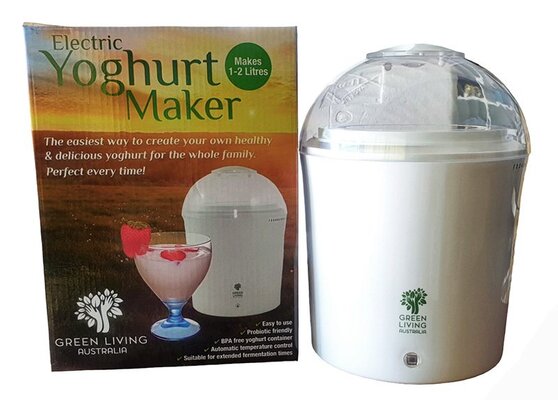
I use this style yoghurt maker.
1433.jpg

It's brilliant for long ferments.
 
Back
Top Bottom